


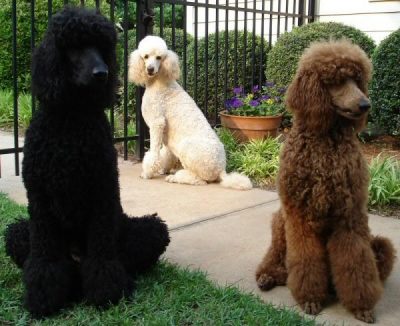
Elegant. Proud. Clever. Poodles are impressive dogs, as the many best-in-show winners from this dog breed can attest. Behind the blue ribbons, impressive hairdos, and regal attitude, you'll find an affectionate family dog with an ancient history and many talents.
Although today's Poodles seem to epitomize a life of leisure and luxury, make no mistake: These are real dogs bred to do real jobs. Although it hardly seems possible when you look at a primped-up Poodle in the show ring, the breed was originally a water retriever, a job that requires jumping in the water to fetch waterfowl for hunters.
In fact, the English name poodle is derived from the German word pudel, or pudelin, which means to splash in the water. And in France, Poodles are called Caniche, a name derived from chien canard, meaning duck dog.Even the elaborate coat styling that the breed's known for once had a practical purpose: trimmed areas lightened the weight of the dog's coat and wouldn't snag on underwater debris, while long hair around the joints and vital organs protected the dog from the cold water.
There are three sizes of Poodle, all considered part of the same breed: going from smallest to largest, these are the Toy, the Miniature, and the Standard. The Standard is probably the oldest of the three varieties, and some still carry on the Poodle tradition of working as a water retriever.
No matter the size, Poodles are renowned for a playful but dignified personality and keen intelligence. When it comes to training, this is an "A" student, and the Poodle excels at performance sports such as obedience, agility, and hunt tests.
Despite his regal air, the Poodle is no snob. These are people-friendly dogs who want to stay close to their families — they get lonely when left by themselves for long periods — and are always up for a good game.
The Poodle is one of the oldest breeds developed especially for hunting waterfowl. Most historians agree that the Poodle originated in Germany, but developed into his own distinct breed in France.
Many believe that the breed is the result of crosses between several European water dogs, including Spanish, Portuguese, French, German, Hungarian, and Russian water dogs. Other historians think that one of the Poodle's ancestors is the North African Barbet, which was imported to the Iberian Peninsula. After that, the breed arrived in Gaul where it was used for his hunting abilities.

It's also commonly believed that Poodles descended from Asian herding dogs, and then traveled with the Germanic Goth and Ostrogoth tribes to eventually become a German water dog. Yet another theory is that the Poodle descended from dogs that were brought out of the Asian steppes by the conquering North African Berbers and eventually found his way into Portugal in the 8th Century with the Moors.
Whatever its ancestry, this is a very old breed. Illustrations of Poodle-like dogs adorn Egyptian and Roman artifacts and tombs dating from the first centuries B.C. The drawings and statues show dogs that look very much like modern-day Poodles, bringing in game nets, herding animals, and retrieving game from marshes.
Although some say that the Miniature and Toy Poodles emerged shortly after the Standard, many believe it wasn't until the 1400s that breeders began producing smaller versions of the Poodle — first the Miniature, then the Toy — to delight the Parisian bourgeoise. The Toy and Miniature varieties were created by breeding small Poodles to each other, not by breeding Poodles to smaller breeds.
The French used the larger Standard Poodle for duck hunting, and the mid-sized Miniature Poodle to sniff out truffles in the woods. The tiny Toy Poodle's main job, on the other hand, was to serve as a companion to the nobility and wealthy merchant class. Well-to-do owners in the Renaissance often carried their Toy Poodles in their large shirtsleeves, leading to the nickname "sleeve dogs."

Gypsies and traveling performers learned that Poodles excelled in another canine profession: circus dog. They trained Poodles to perform tricks, dressing them in costumes and sculpting their coats into fanciful shapes to add to their stage appeal. Wealthy patrons took note and started clipping, decorating, and even dying their own Poodle companions.
Poodles were fairly rare in the U.S. until after World War II. By the mid-1950s, however, the Poodle had become the most popular breed in the country, a position he held for more than 20 years.
There are three sizes of Poodle: toy, miniature, and standard. These aren't different breeds, just different sizes of the same dog. The Toy Poodle stands up to 10 inches tall, and weighs about six to nine pounds. The Miniature Poodle stands 11 to 15 inches tall and weighs 15 to 17 pounds. The Standard Poodle stands 15 inches and taller (usually 22 inches); males weigh 45 to 70 pounds and females weigh 45 to 60 pounds.
Intelligent, loving, loyal, and mischievous are four words Poodle enthusiasts commonly use to describe the breed's personality. The Poodle is also known for what his fans call "an air of distinction": a dignified attitude that's hard to describe, but easy to spot in the dog.
Despite his regal appearance, the Poodle has a goofy streak and loves to play — he's always up for a game of any kind. He's also very fond of people and eager to please. Combine that with his legendary intelligence, and you've got a dog that's highly trainable.
A good Poodle who's been taught canine manners has a calm disposition, especially if he gets regular exercise to burn off his natural energy. Some owners and breeders think the smaller Toy and Miniature Poodles are a bit more high-strung than the Standard; however, other breeders and owners disagree with this theory.
The Poodle is protective of his home and family, and if strangers approach your house, he'll sound a warning bark to let you know. And although he's affectionate with his family, he may take a while to warm up to new people.
An outstanding trait of the Poodle is his intelligence. He is often said to have human-like intelligence, an amazing cleverness that astounds his owners. Of course, smart dogs can be difficult to live with. They learn fast — good habits and bad — and they remember everything.


